Politics is filled with people who refuse to tell you what they really believe.
They claim to be “independent.” They insist they are “down the middle.” They avoid labels, soften their language, and present themselves as neutral observers—even when their records, alliances, donations, and political activism consistently point in one direction.
But eventually, the people deserve a straight answer.
Pick a side.
On August 4, Kansas voters will decide whether Supreme Court justices should continue to be chosen through the current nominating-commission process or be elected directly by the people. A YES vote supports ending the Supreme Court Nominating Commission and moving to direct elections for justices.
This amendment presents a clear choice.
Do you trust the people of Kansas, or do you believe a small group of legal insiders should continue controlling which candidates may even be considered for our state’s highest court?
I trust the people.
Follow the Money
Opponents of the amendment claim they are fighting to keep big money out of the judiciary.
Meanwhile, millions of dollars have poured into the campaign to preserve the current system.
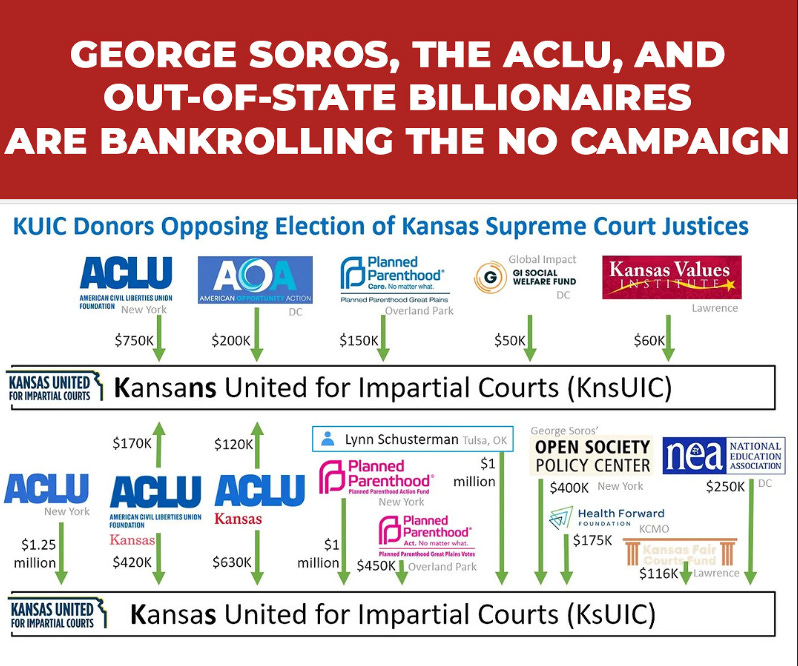
According to a July campaign-finance report, Kansas United for Impartial Courts reported more than $7.6 million in cash contributions and other receipts through July 20, along with more than $260,000 in in-kind support. The organization reported spending approximately $6.6 million during that period.
Earlier official filings showed contributions and in-kind support from organizations including the American Civil Liberties Union of Kansas, the ACLU Foundation of Kansas, and Planned Parenthood Great Plains Votes. The filings also listed expenditures to national political consulting and legal firms.
These groups are entitled to participate in the political process. But they should stop pretending this is a battle between their supposedly pure, nonpolitical system and an amendment corrupted by political money.
The money is already here.
The politics is already here.
The organized ideological interests are already here.
They are simply spending millions of dollars to keep the final decision away from ordinary Kansas voters.
Pick a side.
You cannot condemn big money while pouring millions into a campaign designed to preserve your own political influence.
You cannot lecture Kansans about special interests while national organizations, advocacy groups, political consultants, and well-funded networks work together to protect the current system.
And you cannot claim to be defending democracy while campaigning to prevent the people from directly choosing the members of their own Supreme Court.
“No Kings”—Except the Ones They Choose
We hear slogans such as “No Kings.”
We hear demands to “stop the oligarchy.”
We hear constant warnings about unelected elites, wealthy insiders, unaccountable institutions, and powerful people making decisions behind closed doors.
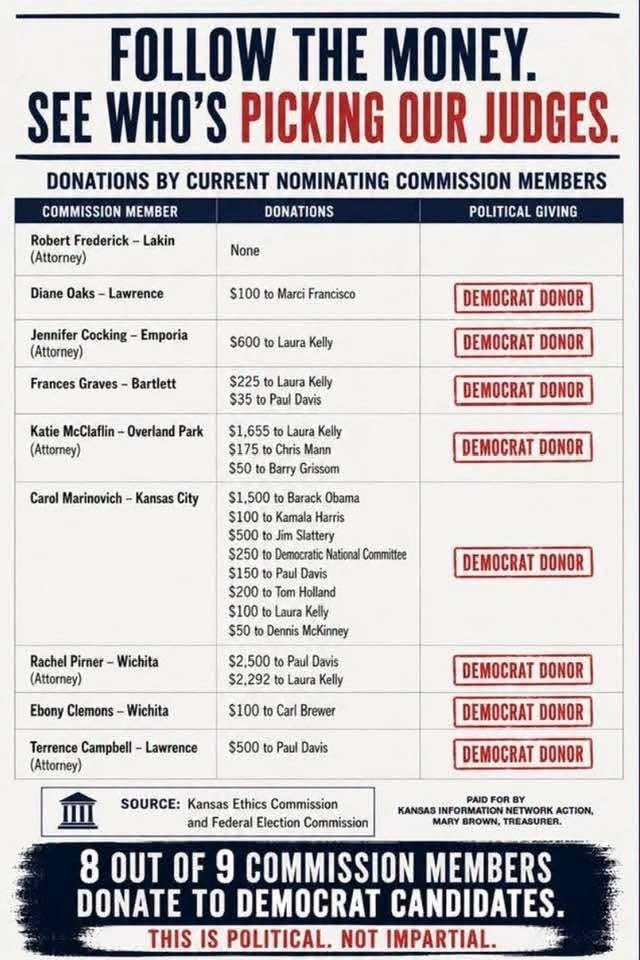
Yet many of the same political organizations using that language are now defending a system in which five members of the nine-member Supreme Court Nominating Commission are attorneys elected only by other attorneys. That commission determines the three finalists from whom the governor must choose a justice.
Apparently, oligarchy is unacceptable—unless it produces the results they want.
Apparently, unelected power is dangerous—unless their political allies control it.
Apparently, democracy is sacred—until Kansans are given the opportunity to vote directly.
That is not a consistent principle. It is political convenience.
Pick a side.
Either you believe concentrated, insider-controlled power is wrong, or you do not.
Either you believe the people are capable of governing themselves, or you do not.
Either you trust Kansans with the decision, or you want to keep the decision inside an insulated legal and political establishment.
The Latest Appointment Shows Why This Matters
Governor Laura Kelly’s latest appointment to the Kansas Supreme Court provides Kansans with a timely example of the power held by the current system.
In July, Governor Kelly selected Douglas County District Judge Carl Folsom III to fill a vacancy on the Supreme Court. Folsom had previously been nominated by Kelly to the Kansas Court of Appeals twice—in 2020 and 2021—and was rejected by the Kansas Senate both times.
Supporters describe Folsom as qualified and emphasize his experience as a public defender and district judge. Critics questioned the narrow focus of his professional experience and objected to elevating a nominee who had twice failed to receive Senate confirmation for the lower appellate court.
Regardless of how one evaluates Folsom personally, the episode demonstrates the central problem.
Kansas voters had no direct say.
The nominating commission controlled the shortlist. The governor made the appointment. The public was left to watch from the sidelines.
A candidate rejected twice for the Court of Appeals could later emerge through the commission process and receive an appointment to the Kansas Supreme Court—without ever facing a statewide vote.
To me, that is not meaningful democratic accountability.
It is further evidence that the current system protects the power of the process rather than the authority of the people.
Politics Is Already in the Courtroom
The opposition says direct elections would “politicize” the court.
That argument requires Kansans to believe politics does not already influence judicial selection.
Commission members have political views. Governors have political views. Attorneys have political views. Advocacy organizations have political views. Applicants possess judicial philosophies that shape how they interpret statutes and constitutional provisions.
The current system does not eliminate politics.
It conceals politics behind the language of “merit.”
Instead of allowing the public to openly examine candidates, their records, their qualifications, and their philosophies, the present system places the critical screening decision in the hands of a small commission dominated by members of one profession.
Opponents say the existing system is impartial. Yet their own campaign is supported by organizations with unmistakable positions on abortion, criminal justice, elections, civil liberties, and other issues regularly decided by the courts.
Again, those organizations have every right to advocate for their beliefs.
But stop hiding your motives.
This is political.
It has always been political.
The only question is whether those politics remain concentrated among insiders or are subjected to the scrutiny and judgment of Kansas voters.
Stop Pretending to Be Neutral
One of the most frustrating habits in modern politics is the activist who claims to be an independent moderate while maintaining a long record of supporting the progressive left.
They insist they are merely defending “good government.” They claim to have no ideological interest. They describe every conservative reform as extreme while treating every liberal institution as neutral and beyond criticism.
Kansans are smarter than that.
We can see the organizations involved.
We can see the money being spent.
We can see the political alliances.
We can see which system they are fighting to preserve.
And we can recognize the contradiction when people who regularly condemn concentrated power suddenly mobilize millions of dollars to protect an unelected, attorney-controlled selection process.
Pick a side.
Do not march under the banner of “No Kings” while defending an institution that limits the people’s authority.
Do not claim to oppose oligarchy while protecting a structure that gives a select group of attorneys a constitutionally privileged role.
Do not warn about big money while operating one of the largest and best-funded political campaigns in the state.
Do not claim to defend democracy while telling Kansas voters they cannot be trusted to choose their own justices.
I Choose the People of Kansas
My position is straightforward.
I believe Kansans are capable of evaluating judicial candidates.
I believe candidates for our highest court should have to answer questions about their qualifications, experience, character, and understanding of the Kansas Constitution.
I believe judicial selection should occur in public—not through a process that limits the governor and excludes the people from the decisive choice.
I believe the legal profession deserves a voice, but it should not possess a privileged constitutional power unavailable to farmers, veterans, teachers, law-enforcement officers, business owners, parents, retirees, and working families.
Most importantly, I believe political power ultimately belongs to the people.
The opposition has chosen its side.
It has raised millions of dollars to preserve the existing system. It has aligned with powerful advocacy organizations and political networks. It has chosen the commission, the insiders, and the status quo.
I choose the people of Kansas.
On August 4, pick a side.
Choose accountability over insulation.
Choose openness over backroom control.
Choose democracy over oligarchy.
Choose the people over the privileged few.
Vote YES—and let the people decide.